The Co-op votes to demonise Israel

May 8th, 2012

Coop supermarket.

The co-operative - good with food. Just not Israeli food.

This article appears in Progress Online.

On 28 April, the Co-operative Group voted to stop trading with Israeli companies that source some of their products from Jewish settlements in the occupied territories. It is the first British supermarket chain to do so.

For those of us who support a two-state solution for Israel and Palestine and who oppose the building of settlements in the occupied West Bank, it is easy to dismiss this as irrelevant. After all, it’s not like the Co-op voted to ban all Israeli products. In fact the Co-op went out of their way to say precisely that. They’re not boycotting Israel. They’re just boycotting companies that profit from the occupation.

But before dismissing the Co-op’s decision as being no big deal, it’s worth having a look at what supporters of Hamas and the Islamic Jihad here in the UK are saying.

The Palestine Solidarity Campaign (PSC), which supports a “one-state solution” which would effectively destroy Israel, is ecstatic about the Co-op decision. “Fantastic news!” they declare on their website. “This important development … shows yet again the growing movement for solidarity with Palestine is having a concrete impact.” They are certain that other supermarkets will follow the Co-op lead.

In the eyes of the PSC, this is a massive win. They’ve managed to extend the boycott of settlement goods to include produce grown inside of Israel proper. They’ve done this by tainting Israeli agricultural export companies as bodies which “profit from the occupation”. This new concept allows one to call for boycotts of all kinds of Israeli companies and institutions not directly linked to the settlements. It’s a patient, one-step-at-a-time campaign pointing toward a complete boycott of Israel.

The Guardian’s account made no attempt at objectivity. Referring to the pro-Hamas PSC as “Palestinian human rights campaigners”, they noted that this was “the first time a supermarket anywhere in the west had taken such a position”. After quoting from several supporters of the boycott (but not the Jewish community in Britain), they concluded their account with a sneering reference to official Israeli policy. “Boycott campaigns against Israel are routinely denounced by Israeli officials as part of a drive to ‘delegitimise’ the Jewish state,” they wrote. Routinely denounced. Delegitimise – in quotes.

British Jews are deeply worried by this development, saying that “the Co-op has not fully understood the Jewish community’s serious concerns with an ever-increasing slippery-slope boycott policy.”

They should not be alone in making this argument. The labour movement should be on their side.

One can and should oppose the policies of the right-wing Netanyahu-Mofaz government. And that includes opposing the building of Jewish settlements in the occupied West Bank.

But to go from there to supporting a boycott of Israeli companies that may have “profited from the occupation” is a step too far.

The PSC’s strategy is absolutely clear and they’re not hiding it. They are taking this one step at a time.

First, persuade groups like the Co-op to not sell settlement goods. Few would speak out against that.

Second, ban goods from companies which source some of their products from the settlements. Again, few voices would be heard against that either.

The next step is to ban all Israeli products on the basis that the Israeli economy and society “profit from the occupation”.

The Jewish community is right to feel under assault. They should not, however, feel alone.

The democratic Left should oppose BDS-by-stealth, and stand with the Jewish community, saying loud and clear — yes to peace, no to demonisation of Israel.

North Korea: Why are unions silent?

May 3rd, 2012

This article appears in this week’s issue of Solidarity.

Kim Jong-un.

Last of the Kim dynasty?

The week leading up to May Day is commemorated each year around the world as “North Korea Freedom Week”, though you’d hardly know that if you were active in the British labour movement. British unions pride themselves on their solidarity campaigns in support of workers in Palestine, Colombia, Venezuela and Cuba, but never speak out in defense of those workers who live in North Korea, a country that is effectively a giant prison.

This year, there was a commemoration in the House of Commons and three North Korean refugees spoke, as well as someone from Amnesty International. Several people commented on the fact that while public opinion can lead to pressure on a number of countries that violate human rights, one hears very little about North Korea in spite of its abysmal record.

And this is particularly true in the labour movement. The International Trade Union Confederation (ITUC) publishes an annual report on violations of trade union rights around the world. For each country, there’s a general description, a few words about the legal situation of workers, and a page about violations of rights. For a country like Israel, the ITUC publishes a long list of rights violations. But the page about North Korea is blank.

Following the same formula for all countries, the ITUC has this to say about North Korea:

“Report violations – 2011. Murders: none reported. Attempted murders: none reported. Threats: none reported. Injuries: none reported. Arrests: none reported. Imprisonments: none reported. Dismissals: none reported.”

One of the mechanisms unions can use on a global scale to combat violations of union rights is the International Labour Organization, a UN body. The ILO has a committee on freedom of association which hears reports of such violations. In its most recent report, the committee mentions the word “Korea” no fewer than 38 times. But every single reference is to South Korea.

Worse than this, some unions actually welcome representatives of the state-controlled North Korean unions as honoured guests at their conferences. Recently, some major South African unions invited the nearly-defunct “World Federation of Trade Unions” (WFTU) to hold a high profile meeting in their country. During the Cold War, WFTU was the home for Stalinist unions but in recent years is host more to various tin-pot dictatorships like the Libyan and Syrian regimes. Heads of the North Korean unions spoke at the WFTU events and at South African union congresses. There were no reports of them being booed off the stage, or better, of them being disinvited.

One of those unions, the public sector union NEHAWU (a sister union to UNISON), proudly lists “international solidarity” as one of its six core principles. And yet they invite representatives of the North Korean regime to speak at their congress, and publish their speeches on the NEHAWU website.

The argument may be made, indeed has been made, that the reason why so little attention is paid to North Korean human rights is that there is so little information leaking out of the country. While it’s true that information about, say, violations of Palestinian human rights are ubiquitous, it is more difficult to find news about North Korea. More difficult, but not impossible.

To prove this point, LabourStart has just launched a special news page which is being updated daily and which includes stories about workers in North Korea. It is located at http://nk.labourstart.org. Recent stories focus on the decision by the regime to export North Korean workers to China as cheap labour. Other stories from Amnesty International and the BBC shed new light on North Korea’s network of slave labour camps.

It turns out that there are plenty of sources of information about the terrible situation faced by working people in North Korea, a country in which an estimated 200,000 people live in those labour camps. That information is out there because of groups like Amnesty International, Human Rights Watch and many groups dedicated specifically to North Korea. There is no reason for trade unions to pretend ignorance any longer.

Workers throughout the world are up against brutal regimes, battling austerity budgets, anti-union campaigns by employers and governments, struggling for the basic human right to join and form trade unions.

But nowhere in the world is the situation worse than in North Korea. For that reason, the international labour movement should sever relations completely with the state-controlled trade unions there and instead campaign in support of North Korean workers, building genuine solidarity with them.

And they should start that campaign right now.

Gegen die Erben Mussolinis

April 21st, 2012

This article appeared in Jungle World.

Modena ist außerhalb Italiens bekannt als die Stadt, in der die berühmten Ferrari-Sportwagen gebaut werden. Doch für Italiener, vor allem für Linke, ist Modena auch die »rote Stadt«, sie war ein Zentrum des antifaschistischen Widerstands in den letzten Jahren des Zweiten Weltkriegs.

Am 28. Oktober vergangenen Jahres versuchten Neofaschisten der Partei Fiamma Tricolore, eine Versammlung in einem Hotel in Modena abzuhalten. Sie wollten Benito Mussolinis »Marsch auf Rom« gedenken und »Kriegsverbrechen« anprangern, die antifaschistische Partisanen angeblich begangen haben. Fiamma Tricolore ist eine besonders widerwärtige Partei der extremen Rechten, die offen Mussolini verehrt und dessen »So­ziale Republik Italien« als Staatsmodell feiert. Die Partei bemüht sich, vor allem junge Menschen für den Faschismus zu begeistern. Sie gehörte zeitweilig zu Silvio Berlusconis Koalition »Haus der Freiheiten«, unter den Sprechern auf der Versammlung im Oktober war ein Lokalpolitiker, der Berlusconis Partei angehört.

Doch die Veranstaltung in Modena verlief nicht ungestört, Gewerkschafter, Kommunisten und andere Antifaschisten protestierten. Sie wurden von der Polizei angegriffen. 14 Protestierende wurden festgenomen, unter ihnen Matteo Parlati, ein junger Ferrari-Arbeiter und Betriebsrat der Gewerkschaft Fiom-CGIL. Parlati wird Widerstand gegen die Polizei vorgeworfen, überdies soll er »moralische Verantwortung« für die Gewalt tragen. Videoaufnahmen zeigen jedoch, wie er von einem Polizisten geschlagen wird. Teilnehmer der neofaschistischen Versammlung wurden nicht behelligt.

Nach Angaben Parlatis und anderer Antifaschisten zeigen Staatsanwälte und Richter Sympathie für die Neofaschisten, auch wenn sie sich sich nicht offen dazu bekennen können, da die nach 1945 verabschiedeten Gesetze die Wiedergründung einer offen faschistischen Partei verbieten. Die Behörden versäumten es nicht, das Management von Ferrari darüber zu informieren, dass Parlati festgenommen wurde und ihn ein Prozess erwartet.

Er muss sich täglich auf einer Polizeiwache in Modena melden, dies erschwert sein Arbeitsleben und macht es ihm praktisch unmöglich, die Stadt zu verlassen. Das bedeutet auch, dass er seinen Aufgaben als Gewerkschaftsfunktionär nicht nachkommen kann, während seine Gewerkschaft in einen Streit von nationaler Bedeutung mit Fiat verwickelt ist. Parlati wird von seiner Gewerkschaft unterstützt, die über Labour Start eine globale Online-Kampagne begonnen hat, um die Behörden von Modena zu zwingen, die Klage fallenzulassen. Viele Gruppen der italie­nischen Linken setzen sich ebenfalls für Parlati ein, auch der Partito della Rifondazione Comunista (PRC), dessen Mitglied er ist. Doch andere sind vorsichtiger, sie wagen nicht, sich in die Tradition der antifaschistischen Widerstandskämpfer zu stellen.

Es geht im Fall Parlati nicht allein um die Verteidigung eines Aktivisten, sondern auch um den Kampf um die historische Erinnerung. Die Faschisten der Fiamma Tricolore versuchen, die Partisanen, die während des Zweiten Weltkriegs gegen Mussolini kämpften, als Kriminelle und Terroristen darzustellen. In einer Stadt wie Modena, in der so viele Antifaschisten getötet wurden, ist eine Veranstaltung zu Ehren der faschistischen Mörder besonders provokativ.

Sympathy for the devil

April 3rd, 2012

Mohamed Merah.

This article appeared in Solidarity.

Mass murderers, and especially those who execute children at point-blank range, are not normally objects of one’s sympathy. It is possible, I imagine, for Nazis to “understand” the motives of a mass murderer, especially one who targets Jews.

But one hardly expects the same sort of understanding or sympathy on the Left.

And yet this is precisely what we find in the latest issue of Socialist Worker.

In a full-page article following up on the Toulouse killings, Jim Wolfreys mentions in the second paragraph that Mohamed Merah’s first attacks took place on the very same day as an American soldier, Robert Bales, went on the rampage in Afghanistan.

One’s first reaction is to think — that’s a quick response by Merah to an attack on his fellow Muslims. But it wasn’t, and that’s not Wolfreys’ point at all.

His point is that “the media tried to comprehend what Bales did by reference to a breakdown brought on by injuries and trauma.”

Now that’s not strictly speaking true.

What most of us saw in the media was shock and horror at what Robert Bales did.

The only attempt to “comprehend” his actions in this way came from his lawyer.

Everyone else, including his Commander in Chief, condemned what Bales did without hesitation.

“Few have tried to do the same in the case of Mohamed Merah,” writes Socialist Worker.

In other words, according to the SWP, Merah needs an advocate.

He needs someone to explain what motivated him to brutally murder unarmed civilians, to deliberately target Jewish children, as well as to execute French soldiers.

Jim Wolfreys complains that “virtually no coverage has been given to claims by Merah’s lawyer that racism” was to blame for his actions.

That may be because of Merah’s own statement explaining what he did — claiming that it was perfectly alright to murder Jewish children because Palestinian children had been killed.

Wolfreys and the SWP want to play the role of devil’s advocate (almost literally in this case) and consider Merah’s own words irrelevant.

He murdered Jewish children not because he was an anti-semitic fascist, trained in the Al Qaeda camps in Pakistan precisely for this mission. No, say Socialist Worker: Merah is a victim of French racism.

This is extraordinary article on a number of levels.

First of all, since when do we as socialists care about whether the convoluted defences concocted by lawyers get their fair share of media coverage?

And how can you compare the insane rampage by Bales which was condemned by everyone, with the actions of a self-described Al Qaeda fighter — whose actions fit right into line with the organisation’s strategy?

Robert Bales was whisked off by the US military and taken to a federal maximum security prison in Kansas, and he will most likely stand trial for his crimes.

But Mohamed Merah was not repudiated by Al Qaeda, and had he been whisked away to its camps in Pakistan he would likely have been hailed as a hero.

But why even make the comparison?

It reminds me of Max Shachtman’s famous quote that whenever Stalinists were challenged about this or that horrible crime in the Soviet Union, they would reply, “But what about your Negroes in the South?”

The core of Wolfreys’ argument is that France is a racist society. And so what? Does anti-Muslim racism justify going on a rampage and butchering children at a Jewish school?

Here is what socialists should be saying — and presumably are saying — in France today:

In the war between Islamo-fascism and bourgeois democracy, the victory of the first would be a tragedy of historic proportions.

That doesn’t justify trampling on civil liberties or spouting Islamophobic messages, as the French Right will do.

But it does mean taking sides against Islamist terrorism, and not seeking to justify it or defend it as the SWP does.

Why I’m not upgrading to the new iPad – and what I’ve chosen instead

March 30th, 2012

I admit it – I’m an early adopter.

That means that I enjoy trying out new technologies, though I can also claim I do this for work reasons as well.  As a consultant to unions that want to work better with new technology, I am often asked for my views on this or that new bit of hardware or software.

I got the original iPad back on the day in came out in the UK.  Actually, the day before it came out.  While Apple fans were queuing up late at  night to be the first to enter the stores, I had simply ordered online – and the iPad was delivered to my door the day before the official release.

I have enjoyed it immensely and use it every day.  It always sits on my desktop, turned on, showing my current to-do list (I use the Toodledo app for that).

But after two years, it has begun to show its age.

Once I started adding photos and music to it, it completely filled up.  (I own the smallest, 16 GB, version.)  I couldn’t download a movie to it.  In fact, the last time I tried, I couldn’t even update the apps – there was no room to download the updates.  I eventually deleted the photos and music just to clear room.

But I’ve also noticed a couple of downsides to the iPad over the last two years of intensive use.

The main thing is its size – it’s simply too large to use all the time, especially when travelling.  I’m self-conscious if I take it out on a bus or train.  (Though more and more people do this.)

And it’s heavy too — uncomfortably so for long-term use.

So naturally I was excited when Apple released the iPad 2 last year and the new iPad this year.

But I didn’t upgrade last year because I didn’t think the iPad 2 added enough value to justify the investment.

And I didn’t upgrade now because I’ve found something better.

Yesterday, to reward myself for a small personal achievement, I went out and purchased the Samsung Galaxy Note.

This device is being marketed as a cross between a phone and a tablet.  It is either a very large phone (think Dom Joly in “Trigger Happy TV”) or a very small tablet.  The screen is 5.3″, less than half the size of the iPad screen.

So what are the reasons to go with this rather than a new iPad?

Here are some:

It’s a phone – and I carry my phone everywhere, though I often leave the iPad at home.  This means that I’ll now be carrying a tablet everywhere, making it far more useful as it will always be at hand to jot down ideas, tasks, etc.

It has two cameras, one of which at 8 MP is as good as many stand-alone cameras, and certainly for one like myself who’s not very good at taking photos, this will more than suffice.  It will shoot high-definition video as well. The best thing is that I hardly ever take my normal digital camera anywhere — I even forget it when going on holiday — but this is a camera that will always be in my pocket.  They say the best camera is the one you have with you at the time you need to take photos, so for me, this is the best camera I could ever own.

It’s very light — about one fourth the weight of my iPad — so it should be easier to hold for long periods of time.  One of the time-intensive things I do with the iPad on flights and long train rides is to read books on it.  I was an early adopter of e-readers, having read books on my old Palm Tungsten C nearly a decade ago.  (Here’s an essay I wrote on the subject eight years ago – back in April 2004.)   The screen size is also a close approximation of a paperback book than the 10″ screen on the iPad which is more suited to large-format books or magazines.

Because I purchased it from Three, with unlimited data, it means I will have always-on access to the net, something which I missed with my (non-3G) iPad.  So now, sitting on a bus, I can check my emails at no cost and at high speed, I can look at the news, see how my campaigns are going, and so on.

I’m still exploring the device, having owned for it little more than 12 hours, and have begun downloading the apps that I consider essential, but which are not included.  I have found the use of Google Play (formerly Android Market) to be very easy, perhaps even easier than Apple’s App Store.  Here are some of the apps I’ve added to the phone on the first day, in no particular order:

  1. TuneIn Radio Pro – to listen to radio stations from around the world
  2. Twitter
  3. Facebook
  4. The Guardian
  5. WhatsApp Messenger – highly rated messaging app, haven’t yet tried it
  6. BBC iPlayer – tested this and screen is terrific
  7. Sky Map – keen to test this on a clear night sky
  8. Evernote
  9. TimeOut London
  10. Kindle – have continued reading Christopher Hitchens’ autobiography where I left it off on the iPad
  11. Libra – records my weight, linked through the net to my Withings wi-fi scale
  12. Ultimate ToDo List – syncs with Toodledo
  13. BBC News
  14. FitBit – syncs with my FitBit device (a pedometer on steroids)
  15. Jamie Oliver’s 20 Minute Meals – a bit ambitious, I know …
  16. Skype – essential for videoconferencing, and keen to try this

I have more apps on my list, but this will do for a start.

I’ll update once I’ve used this for a few days and will let you know how it’s going and what I’ve learned.

Bayard Rustin, 1912-2012

March 23rd, 2012

Bayard Rustin.

This March marks the 100th anniversary of the birth of Bayard Rustin, the American civil rights leader who passed away in 1987.  Rustin is remembered as the organiser of the great 1963 March on Washington at which Martin Luther King gave his “I have a dream” speech.

But to socialists, Rustin’s legacy is richer than that.

I first met Rustin some 40 years ago when he agreed to co-chair the Socialist Party together with Michael Harrington and a long-forgotten Jewish trade union leader named Charles Zimmerman.

Rustin was at that time already unfashionable on the left because of his strong opposition to Stalinism and his unflinching support for the state of Israel.

I was to learn later on in life that being unfashionable was nothing new for Bayard.  He was never fashionable, and always championed the causes he believed in, regardless of how unpopular it might make him.

He began his political career with a brief membership in the Communist movement, though he quickly resigned in the wake of the Hitler-Stalin pact.  But his being an “ex-Communist” was to haunt him later in life, when Southern racists in the US Congress were to accuse of him of every sin they could think of.

Not only was Rustin a red, they would say, but he was a draft-dodger and a homosexual.

Rustin’s response was to say that he did indeed refuse to serve in the second world war due to his pacifist convictions — and he paid the price for that.

As for his sexual orientation — and this was back in 1963, long before the Stonewall uprising — he denied nothing.  He told his accusers to raise that issue, if they dared, with his employers.  Later in life, Rustin became an outspoken advocate of gay rights.

Today Rustin’s sexuality, his early flirtation with Stalinism and his pacifism make him to a certain degree acceptable to some parts of the left.

But in his lifetime, his views on the Cold War and on Israel won him few friends on the left.

Rustin moved in the same circles as Max Shachtman, and eventually shared Shachtman’s views on issues like the Vietnam War.  While many on the left supported a Communist victory in Vietnam, seeing Ho Chi Minh as some kind of Vietnamese George Washington, Rustin took a more nuanced view, and supported a negotiated settlement that might result in an American withdrawal from the country without necessarily giving Ho control of the south.

When the North Vietnamese army triumphed in 1975, Rustin spoke out at small, hastily-organized demonstrations called to highlight the plight of the “boat people”.

Rustin, like his mentor, the legendary A. Philip Randolph, was a lifelong supporter of the trade union movement.  He set up the A. Philip Randolph Institute which for decades served as the centre for Black trade unionists and build strong ties between the Black community and trade unions.  And he did this despite the overt racism of many of those unions — a racism he fought against from within the movement, and not as an outsider.

Like most Black leaders in the US in the early 1960s, Rustin felt very close to the Jewish community and the state of Israel.  The bonds formed in the early days of the civil rights movement between Blacks and Jews were still quite strong.

When this became unfashionable following Israel’s victory in the 1967 Six Day War and a bitter teachers’ strike in New York City, Rustin remained firm in his beliefs.  As tensions increased between the Black and Jewish communities, Rustin organized the Black Americans Support Israel Committee (BASIC) and continued to push for reconciliation between the two communities.

He was by no means uncritical of the Israeli government.  On his visits to Israel he pushed hard for better and fairer treatment for the small community of “Black Hebrews” who had settled in the country’s south.

I met Bayard on a number of occasions but the most memorable, to me, took place in 1974.  I was then a student at Cornell University, which had established a dormitory for Black students at the same time as many college fraternities were still  “whites only”.  Our small socialist student organisation campaigned against this renewed form of segregation, pitting us against the campus left which tended to support Black separatism as if it was somehow progressive.

Bayard organised a public message signed by himself and other key Black leaders supporting us, as we were standing in the great tradition of the fight against Jim Crow. And then he agreed to fly up to Cornell and give a public speech on the subject.

We were very concerned about security as emotions were running high, and naively asked Bayard over dinner what he wanted us to do — should we involve the campus police?  Absolutely not, he said.  The police are never welcome at our meetings.

Bayard spoke to a packed hall full of young Black students with a handful of white socialists in the back.  I won’t say that he won them over — that would have been impossible, even for someone with Bayard’s considerable rhetorical skills.

But he did challenge them, and raised the question of — as he put it — “tribalism”.

It was not fashionable to oppose Black separatism back then, in the early 1970s.

But Bayard Rustin never gave a damn about being fashionable.

Kalter Kaffee

February 17th, 2012

This article appears in Jungle World today.

Bei seinem Indonesien-Besuch in der vergangenen Woche entschied der ehemalige britische Parlamentsabgeordnete George Galloway offenbar, das weltweit bevölkerungsreichste muslimische Land könne eine gesunde Dosis des guten, alten Antisemitismus gebrauchen. Im vergangenen Jahrzehnt hat sich der Irakkriegsgegner einen Namen als Großbritanniens führender Verteidiger arabischer Diktatoren kurz vor ihrem Abgang gemacht. Er war ein großer Bewunderer Saddam Husseins und scheint auch ein Fan von Bashar al-Assad und Mahmoud Ahmadinejad zu sein. In Jakarta machte er sich anscheinend Sorgen darüber, dass die Indonesierinnen und Indonesier der heiligen Sache der Zerstörung des einzigen jüdischen Staates nicht die nötige Aufmerksamkeit entgegenbringen, also ermutigte er sie, ihre Bemühungen zu verstärken. »Ich sagte ihnen, dass es in Jakarta vielleicht keine israelische Botschaft gibt, aber Starbucks gibt es an jeder Ecke und dort wird die israelische Flagge geschwenkt«, wies Galloway die indonesischen Muslime netterweise auf ein naheliegendes Ziel für antiisraelischen Protest hin.

Einige mögen mit Starbucks ein Unternehmen verbinden, das seinen Beschäftigten nur den Mindestlohn ohne Zuschläge zahlt und jeden feuert, der es wagt, sich gewerkschaftlich zu organisieren. Aber das stört Galloway nicht, dessen Tage in der Labour Party, aus der er 2003 ausgeschlossen wurde, längst der Vergangenheit angehören. Wie er während seiner Asienreise einige Tage zuvor in Malaysia wissen ließ, »übergibt Starbucks jedes Jahr einen großen Scheck an Israel und betreibt in jeder illegalen Siedlung auf dem besetzten palästinensischen Territorium ein Café«. Was übrigens nicht stimmt. In Israel gibt es keine Starbucks-Filialen mehr.

Offenbar glaubt Galloway an die Mär, dass Starbucks von jedem verkauften Latte Macchiatto einen gewissen Anteil an die israelische Armee spende. Die Profite des Unternehmens würden verwendet, um Waffen mit weißem Phospor zu kaufen. Solche Behauptungen kursieren im Internet. Dass es sich bei dem berüchtigten Brief von Howard Schultz, dem Gründer von Starbucks, in dem er all dies zugibt, um eine Fälschung handelt, ist ausreichend belegt. Das Gleiche gilt für die »Protokolle der Weisen von Zion«, doch das verhindert nicht, dass sie die Bestsellerlisten quer durch die muslimische Welt anführen. Galloway reist weiter durch Asien.

Long live free Georgia!

February 3rd, 2012
Long live free Georgia!

The film-within-a-film, "The Russian Affair" - the hero escapes Bolshevik captivity to continue the fight for a free Georgia.

This article appears in the current issue of Solidarity.

The opening scene of Michel Hazanavicius’ new film, “The Artist”, is a movie within a movie.

It’s the final moments of a fictional 1927 silent film. The hero is being tortured, and those paying close attention will see that the torturers are Russians. (The dials on their machines have Cyrillic characters.)

The hero breaks free, rescues the girl, and flies off to freedom. His last words, which appear as a title card, are “Long live free Georgia!”

My guess is that Hazanavicius was looking for something that would seem authentic in the 1920s, something sufficiently obscure that it would have an air of being genuine. To have the hero of this adventure fighting for Georgia is about as obscure as you can get.

I’m sure audiences in the USA are convinced that it must have something to do with the state of Georgia.

But we know better.

In the 1920s, the plight of the formerly independent Georgian republic was very much in public view. And this was particularly true on the left.

Georgia, which had been a province of the tsarist empire, declared independence in 1918 and was led by Mensheviks.

In 1921, the Red Army invaded — probably at the instigation of Stalin, and without the knowledge of Trotsky.

The Mensheviks were quickly routed and many of their leaders fled to exile in western Europe.

From there they continued a long struggle to delegitimise the Russian occupation of their country. A large part of the struggle took place within the international socialist movement.

Leading socialists from across Europe travelled to Georgia in its final months, the most prominent of these being Karl Kautsky.

Kautsky wrote a book praising the Menshevik success in Georgia, citing it as an example of a democratic socialist alternative to Bolshevism. He contrasted the multi-party system, free press and independent trade unions of Georgia with repressive regime in Soviet Russia.

Trotsky countered with a vitriolic attack on the man formerly known as “the pope of Marxism” and defended what turned out to be the first successful Soviet invasion of a neighbouring country (others were to follow).

In Britain, the cause of Georgia was so well-known and widely discussed that the TUC eventually sent a trade union delegation to investigate. For years the Georgian social democrats in exile participated as honoured members of international socialist congresses.

Just three years after the Red Army seized Tbilisi, the Georgians rose up in a violent insurrection against Soviet rule. Leaders of the Menshevik People’s Guard led the uprising, but it was eventually crushed.

Within a decade there was little left of the Georgian Mensheviks in their homeland.

The new Georgian Soviet Socialist Republic was the kind of place where psychopath like Lavrenty Beria could rise to power. Beria was so successful in brutally terrorising the local population that Stalin eventually promoted him to head the secret police throughout the Soviet empire.

Though the Mensheviks died off one by one in exile, the memory of Georgian independence never did. Georgia remained for decades a centre of anti-Soviet activism, culminating in mass street protests in the 1980s.

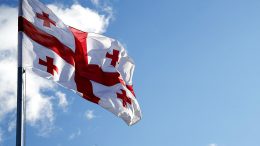
When the Soviet Union collapsed, the Georgians proclaimed independence and chose as their symbol the flag of the short-lived Menshevik republic. They made the date of the Menshevik’s declaration of independence their national holiday. And for a few years at least, the constitution of the Menshevik republic was back in force.

But the 1990s were to prove a turbulent time in Georgia, with civil wars and a series of failed leaders.

The country is currently ruled by the right-wing Saakashvili regime, whose record on workers’ rights has attracted the attention of the international trade union movement.

One of the first things Saakashvili got rid off when coming to power was the hated crimson flag of the Mensheviks.

To Michel Hazanavicius, the slogan “Long live free Georgia!” must have seemed to be as obscure as it gets, a historical curiousity, something that would appeal only to trivia buffs.

But to socialists, “free Georgian” is a reminder of a historical tragedy.

Ölarbeiterstreiks in Kasachstan

January 21st, 2012

This article appears in the current issue of Jungle World.  A Russian translation is here.


Im Parlament Kasachstans wird es künftig mehrere Parteien geben. Das ist nach der Wahl am Sonntag so sicher wie der Sieg der Regierungspartei Nur Otan, denn Präsident Nursultan Nasarbajew wollte es so. Die nun im Parlament zugelassenen Parteien stehen dem Regime nahe. Oppositionelle Kandidaten waren auch diesmal nicht zugelassen. Dass Nasarbajew es für nötig hält, seinem Regime den Anschein von Pluralismus zu geben, wird auf die wachsende Unzufriedenheit im Land zurückgeführt.

Deren deutlichster Ausdruck ist ein seit Monaten andauernder Ölarbeiterstreik in Zhanaozen. Am 16. Dezember kam es in dieser westkasachischen Stadt zu Demonstrationen und Unruhen, mindestens 16 Menschen wurden getötet. Noch immer gilt dort der Ausnahmezustand. Der Hintergrund des Konflikts ist umstritten. Den Unterstützern des trotzkistischen Committee for a Workers’ International (CWI) zufolge gab es ein nicht provoziertes Massaker an unbewaffneten Streikenden durch die Polizei. Das CWI zog sogar Parallelen zu den »Juliaufständen« des Jahres 1917 im russischen Petrograd. Damals kam es zu spontanen Demonstrationen von Soldaten und Arbeitern gegen die Übergangsregierung. Die Bolschewiki versuchten, die Demonstrationen zu dominieren und die Regierung zu stürzen. Diese reagierte sehr repressiv und schoss Hunderte friedliche Demonstrierende nieder.

Aktivisten kasachischer, russischer und internationaler Gewerkschaftsbewegungen kritisieren jedoch das CWI. Die streikenden Ölarbeiter seien manipuliert und von Außenstehenden provoziert worden, was zu den tragischen Ereignissen geführt habe, bei denen Gebäude niedergebrannt wurden und Gewalt von beiden Seiten ausging. Auf der einen Seite steht der Vorwurf des Verrats, auf der anderen der Vorwurf, dass sich eine kleine Gruppe linker Abenteurer mit kasachischen Oligarchen, die gegen das derzeitige Regime opponieren, verbündet und eine Massenbewegung in eine unausweichliche Niederlage geführt habe.

Der Streik der Ölarbeiter begann im Mai des vergangenen Jahres. Sie verlangten anfangs höhere Löhne, seit kurzem gehört zu ihren Forderungen auch die Nationalisierung des Ölsektors. Ihrem illegalisierten Streik wurde von Anfang an mit Gewalt und Repression begegnet. Eine die Arbeiter vertretende Anwältin wurde zu sechs Jahren Haft verurteilt, einige Unterstützer und ihre Kinder fielen Morden zum Opfer.

Doch gebe es, so eine Stellungnahme der International Union of Foodworkers, keine gewählten Repräsentanten der Arbeiter, die mit der Unternehmens- und Staatsführung verhandeln könnten. So sei eine Gelegenheit für von außen kommende Gruppen wie das CWI entstanden, eine Führungsrolle einzunehmen und zu beanspruchen, für die Arbeiter zu sprechen.

Paul Murphy aus Irland, ein Abgeordneter des EU-Parlaments und Mitglied des CWI, flog in die Region, traf die Streikenden und hielt Pressekonferenzen ab. Kritiker des CWI sagen, Murphy habe den Streikenden Hoffnungen gemacht und sie so dazu gebracht, anzunehmen, dass sie nur seine Unterstützung und keine eigene Organisation bräuchten. Er und seine Gruppe spielten eine führende Rolle in der Kampagne, die sich nicht nur gegen die autoritäre Regierung Nursultan Nasarbajews richtete, sondern auch gegen die internationale Gewerkschaftsbewegung.

Das hat den Verbänden eine Solidarisierung nicht erleichtert. Sie fühlten sich nicht willkommen, so dass selbst auf das Massaker am 16. Dezember keine Reaktionen folgten. Zum Beispiel sträubte sich die für den Ölsektor verantwortliche globale Gewerkschaftsföderation ICEM dagegen, sich mit einem Konflikt zu befassen, in dem sie ständig das Ziel von Attacken seitens des CWI ist. Eine andere globale Gewerkschaftsföderation, die International Transport Workers’ Federation, gab eine klare Stellungnahme ab, die das Massaker verurteilte.

Der internationale Gewerkschaftsbund ITUC, dessen Präsident Michael Sommer vom DGB ist, reagierte auf die Gewalt vom Dezember mit einer ausgewogenen Erklärung, ohne die ganze Schuld dem Regime zuzuschieben. Ähnlich äußerte sich Sharan Burrow, die Generalsekretärin des ITUC: »Die Gewalt muss sofort aufhören, und alle Beteiligten müssen anerkennen, dass die einzige Lösung für den Konflikt ein offener Dialog und Verhandlungen sind.« Das kann wohl nicht als eine klare Anklage einer Seite verstanden werden.

Videos von jenem Tag können kaum zur Aufklärung beitragen. Auf einigen sind Zivilisten, wahrscheinlich Streikende, zu sehen, die auf einer Bühne Lautsprecher und andere Gegenstände umstürzen, die für die Feierlichkeiten am Unabhängkeitstag vorgesehen waren. Andere Videos zeigen schwerbewaffnete Polizisten, die Demonstrierende jagen und auf sie schießen. Niemand streitet ab, dass mehrere Gebäude niedergebrannt wurden, unter anderem das Rathaus und der Hauptsitz des Ölunternehmens. Unterstützer der Streikenden behaupten, dass jegliche Gewalt von der Polizei provoziert worden sei.

Auch wenn die internationale Gewerkschaftsbewegung in ihren offiziellen Handlungsmöglichkeiten beschränkt ist, unterstützte sie inoffiziell zwei Online-Kampagnen des Gewerkschaftsportals Labour Start. Die zweite, erfolgreichere Kampagne, die am Tag der Morde in Zhanaozen begann, wurde von internationalen Gewerkschaftern betrieben. Sie fordert von der Regierung Kasachstans, »die Gewalt gegen friedlich protestierende Ölarbeiter und ihre Familien in Zhanaozen sofort zu beenden«.

Eine unabhängige Berichterstattung ist in Kasachstan nicht möglich, überdies versuchte das Regime mit aller Macht auch andere Kommunikationskanäle im Land auszuschalten. Aber kürzlich erschienene Berichte weisen darauf hin, dass die ersten Schätzungen, die die Regierung bezüglich der Anzahl der Getöteten und Verwundeten veröffentlicht hatte, zu niedrig gewesen sein könnten. Selbst wenn die Umstände der Straßenkämpfe unklar bleiben, steht außer Frage, dass die Polizei exzessive Gewalt angewendet hat.

Derzeit hat sich die Lage in Zhanaozen beruhigt. Die Arbeiter hielten wieder friedliche Demonstrationen ab. Trotz des Ausnahmezustands wurde am Sonntag auch hier gewählt, ein Kor­respondent der Nachrichtenagentur Reuters berichtete jedoch, es herrsche ein Klima der Angst in der Stadt. Nach offiziellen Angaben erhielt Nur Otan in Zhanaozen 70 Prozent der Stimmen.

Seit der Unabhängigkeit von der Sowjetunion vor 20 Jahren regiert Nasarbajew ohne legale Opposition, daran wird auch diese Wahl nichts ändern. Die Organisierung einer unabhängigen Gewerkschaft in dem für das Überleben des Regimes essentiellen Ölsektor wäre eine ernste Herausforderung. Derweil diskutieren Aktivisten in Russland und anderen Ländern die nächsten Schritte. Man einigte sich darauf, Geld für die Familien der Streikenden zu sammeln, insbesondere für diejenigen der Getöteten und Verwundeten. Und trotz der standhaften Feindseligkeit des CWI setzen globale Gewerkschaften ihre Kampgane fort, um Druck auf das Regime Nasarbajews auszuüben. Es muss für die Gewalt verantwortlich gemacht werden.

Building the revolution

January 20th, 2012

This article appears in the current issue of Solidarity.

Building the revolution.I bought tickets back in November for the “Building the revolution” show at the Royal Academy and was given a 10:00 AM admission time. When I phoned to ask if it would be possible to come later, they told me not to worry — the show was not very popular and it wouldn’t be crowded at any time.

So the good news is, they were wrong.

When I finally did get to see this exhibition, subtitled “Soviet Art and Architecture 1915-1935”, it was absolutely packed with people. Clearly many are interested in the subject.

On a cold Saturday afternoon in London, there were hundreds of people of all ages walking past an enormous model of Vladimir Tatlin’s Monument to the Third International and then wandering through a series of rooms showing everything from an industrial bakery to special housing constructed for the Cheka, the Bolshevik’ secret police.

And delighted as I am that so many people seem to be interested in one of the most revolutionary experiments ever undertaken, I left the exhibition feeling deeply disturbed. Let me explain why.

The idea that revolutionary politics, that changing the world, is somehow a part of the distant past, something that we modern people can look back it the same why we look at earlier civilizations, is somehow … wrong.

This exhibition with its cold, academic descriptions, was filled with people staring at photos of buildings — both as they were in the 1920s and as they are now — and then commenting on what they liked and didn’t, just as one would do with, say, Etruscan statues in the British Museum or medieval paintings of the infant Jesus.

“I like that one,” someone would say. “And that’s very ugly, isn’t it?” asked another.

But the ideas expressed — if one bothered to read the texts — were extraordinary, and deeply relevant to our time. This is not ancient history, and shouldn’t be presented as such.

For example, there was whole section devoted to early Bolshevik experiments with collective housing for workers. These massive structures included vast communal areas, common dining rooms, kitchens, laundries, libraries, kindergartens, wide hallways to allow social interaction, and relatively small sleeping areas. I was reminded of the Israeli kibbutzim, but on an urban scale.

It also struck me how so much of this architecture — like the kibbutz itself — seemed to define its vision of new society in terms of the liberation of women. Women living in such housing would not be expected to cook and clean, or even to be the primary carers of children. All of this was done collectively.

The involvement of revolutionary architects in the design of bakeries and garages and dams was also extraordinary. It expressed the idea that the places ordinary people spent their days — their work-places — should be designed thoughtfully, with some degree of respect for the people who work there.

The exhibition gave no indication of what preceded these buildings — we didn’t see what workers’ housing looked like under the tsarist regime, or what factories looked like before the 1917 revolution.

Without that context, and without any political understanding of the ideas of Marx and Lenin, the exhibition was like any other, showing any random country and period of history.

Nor does the decline of experimental art and architecture in the increasingly Stalinised Soviet Union get an explanation. We see Lenin’s absurdly grandiose tomb, the resting place of his mummified corpse to this day. And we’re shown details of housing built in Moscow for the party elite, the new ruling class. There is no sense that there is some kind of break here, that the revolution has been defeated, replaced by a new kind of class society.

If one knows something of the history of revolutionary Russia, the experience of seeing such works can be quite moving. There was a genuine sense of artistic and cultural liberation in the first years of Bolshevik rule.

But taken out of context, all one sees in this exhibit are objects, which one may judge according to individual tastes.

The great ideas that stood behind them — equality, freedom, social justice — have disappeared from view.