" /> Eric Lee: May 2008 Archives

« April 2008 | Main | June 2008 »

May 23, 2008

There's a battle outside ragin': Unions take centre stage in the fight for democracy

For those of us who support the growth of democracy in the world, it almost goes without saying that we support workers' rights and trade unions. But sometimes that support is only perfunctory.

After all, when we think about dictatorships in the world today and the struggle for democracy, we usually think of political and spiritual leaders, writers, intellectuals and others before we think of the workers. Aung San Suu Kyi and the Dalai Lama have become household names. For some of the larger and better known human rights organizations, workers' rights have long been seen as a bit of a footnote -- though there is some evidence that this is now changing.

While most of us will be vaguely familiar with key international human rights documents, such as the Universal Declaration of Human Rights (1948), most human rights campaigners will have difficulty naming the eight core conventions of the International Labour Organization (ILO) which lay out what are universally recognized workers' rights -- such as the right to form and join a trade union and to bargain collectively.

Everyone remembers the central role played by independent trade unions in bringing down Communist rule in Poland and triggering the collapse of the entire Soviet empire in the process. But my guess is that few are aware of the key role being played by trade unions today -- unions which find themselves on the front lines of what amounts to a fight to the death with dictatorships. Those dictatorships are often far more severe in their repression than the Polish Stalinists ever were.

Take for example, Zimbabwe. As I write these words, most democrats and human rights supporters will be aware that Robert Mugabe's brutal dictatorial rule has faced its most serious challenge at the hands of a man who formerly lead the country's trade union movement -- Morgan Tsvangirai. But how many know that unions today came under severe pressure in the aftermath of the 2008 elections? In early May the top leadership of the Zimbabwe Congress of Trade Unions as well as leading teacher unionists were jailed by the regime and denied bail. Unions in Zimbabwe cannot fail to remind us of the role played by Solidarnosc in Poland -- right down to the union leader (Walesa then, Tsvangirai now) personifying the need for change.

The role of unions in the battle for freedom in Zimbabwe was made even more dramatic by the remarkable action of South African dockers. Following the recent elections in Zimbabwe, members of the South African Transport and Allied Workers Union refused to off-load weapons from a Chinese ship, weapons which were bound for Zimbabwe. The union members did this in the face of their own timid government, which to its shame has failed to act decisively in support of the people of Zimbabwe.

In Iran, most people see a battle between "reformers" and hardline fundamentalists, or perhaps are aware that Iranian women and dissident intellectuals are in a constant battle for rights. Few, however, will know of the central role played by Iranian unions -- unofficial, independent unions not controlled by the regime. There have been strikes and demonstrations around the country, often mobilizing thousands, but the most extraordinary story has been the fight of the Tehran bus workers for union recognition and improved pay and conditions. When those workers brought Iran's capital to a halt with what amounted to a general strike a couple of years ago, the regime reacted with savage repression. The union leader -- Mansour Osanloo -- has been repeatedly jailed and has become a symbol, perhaps the symbol, of the struggle for a new society in Iran.

Iraqi unions play a central role in the efforts to create a democratic and secular society in their country and have paid a heavy price for their efforts. There are many decent people in Iraq risking their lives every day, but unions may be unique in their ability to reach across ethnic sectarian divisions and unite Iraqis in the fight for a better future. They are certainly doing what no political party in that country has been able to do.

The same story is repeated everywhere dictators rule: unions, and sometimes unions alone, stand on the front lines against vicious repression. In China and Vietnam, extraordinary large-scale strikes have rocked the foundations of the Stalinist regimes. Unions in Burma, Eritrea and Belarus have been targetted repeatedly by the dictators in an effort to crush independent thought and action.

As George Orwell might have noted, the hope -- if there is any hope -- still lies with the proles.

This is not how the far Left sees it, however. When I've launched an online campaign that focussed attention on violations of workers' rights in places like Zimbabwe, Eritrea, Burma, Iran and Belarus, I am often sent emails by comrades eager to point out that in supporting workers in those countries, I'm somehow supporting George Bush and the neo-conservatives.

The knee-jerk anti-Americanism here is so powerful, that sometimes people find themselves defending regimes they know almost nothing about (Eritrea? Belarus?) simply because they heard that America might not be fond of this or that particular dictator. My enemy's enemy must be my friend -- and the workers be damned.

On the other hand, if you can find a regime which is backed by Washington and in which trade unionists are denied their rights or even killed, you can get the entire left on your side. What this means in practice is that when right-wing death squads kill trade unionists in Colombia, it gets considerably more attention and support from the left (and unions) than when Ba'athist or Al-Qaeda death squads kill trade unionists in Iraq.

Fortunately, the overwhelming majority of trade unionists do not share the view of the totalitarian left.

Global campaigns in support of embattled trade unionists are bigger than ever before. Earlier this year, the International Transport Workers Federation staged a huge global day of action in support of Osanloo and jailed Iranian union leaders. Their affiliates on every continent, in dozens of countries, and in Muslim countries as well, took to the streets to demand freedom for their Iranian brothers and sisters. A delegation of trade unionists from Indonesia travelled to Iran and attempted to meet with their jailed comrades.

Amnesty International is taking an increasing interest in workers' rights, adopting a number of jailed trade unionists as prisoners of conscience. Recently when Amnesty launched an urgent action in support of one of the jailed Iranian unionists, it turned out to be their biggest, quickest mobilization ever. Clearly there is a lot of public support, certainly within the unions, for international solidarity.

All this is going to prove to be particularly difficult for what remains of the totalitarian Left. Defending Mugabe or the Iranian mullahs is getting less and less popular. The heroism of trade unionists who risk their lives (and in many cases, give their lives) in the battle against these dictatorships inspires thousands.

There's an opportunity here to build a great global coalition, anchored in the trade union movement, allied with traditional human rights groups and pro-democracy campaigners, that struggles to create a better world. In that world, the promises made in Article 23 of the Universal Declaration of Human Rights -- including "everyone has the right to form and to join trade unions" -- could become a reality.

-30-

May 22, 2008

Linux after one year

As I discovered entirely by accident, today marks the end of my first year using Linux.

When I began, I wrote a number of updates for my blog with titles like 'Linux: the first nine days' or 'Day Eleven: The experiment continues'. I think I was amazed that it could go on like that, day after day.

There were probably two reasons for my own surprise at how well it has gone.

First, I'd had a bad experience using Linux in 2002. And second, I hardly knew anyone who used Linux on their desktops. (I still don't know of a single trade union anywhere that has moved over to open source -- unfortunately.)

After one year using Linux, I can say with confidence that I'm never going back to Windows.

Keep reading ...

My use of Linux has actually grown over the year. The computer it was installed on -- an old HP laptop -- was stolen from me, and I purchased a lovely Toshiba laptop and immediately installed Ubuntu Linux on that. (There's Windows XP somewhere on that laptop, in another partition, I think -- but I've never needed it, not once.)

I purchased a very inexpensive Dell laptop with Ubunu pre-installed for a family member and the replacement for my broken Palm handheld is the new Asus eee ultraportable -- running Xandros Linux. So we're now a three-Linux household.

The only computer around here not running Linux belongs to my son -- and he uses his entirely for gaming. (Yes, I know that he can play 'World of Warcraft' under Linux by running Wine, but ...)

One of the great things about the move from Windows to Linux these days is that for many of us, it's completely pain free, with no learning curve to speak of.

For example, the applications I use day in and day out -- my web browser, my email client, my calendar, my task list, my spreadsheet, my processor and my Voice over Internet Protocol (VoIP) client are all cross-platform. They are the same ones I'd be running on Windows.

I've often felt that if you could get Windows users to do what I had already done and move over to Mozilla Firefox, Thunderbird and Lightning for their web, email, calendar and task lists, to Open Office for spreadsheets and word processing, and Skype for Internet telephony, you were nearly there. You could then sneak into their offices when they weren't looking and install Ubuntu instead of Windows -- and they'd never know the difference.

Of course the argument would go -- if Linux is no different from Windows, why bother to make the change?

So I'll repeat some of the thoughts I had back in May 2007 which are still valid today -- and some new ones.

Linux saves me money. I don't pay for a great email client or an office applications suite or anti-virus program. And it didn't cost me anything to get Ubuntu Linux at all. I haven't spent a penny on software all year.

Linux keeps my computer secure. I don't have to worry about viruses, trojans and so on. It's not just that Linux has so small a market share that virus-writers don't bother. Linux is also inherently more secure; it has a more secure architecture.

Linux keeps my computer up to date. Every morning, Ubuntu automatically updates my computer with the very latest software. If there's a security problem in, say, my email program, it's taken care of the same day. In Windows, there's nothing remotely like this. If you use Windows and there's a security problem with, say, Adobe Acrobat Reader or Apple iTunes, you have to get your updates from those companies individually -- it's not built into Windows. Nearly every Windows PC I've seen runs old, outdated, insecure software. But every version of every program I use is the very latest one -- the most secure, fastest and feature-rich versions available.

Linux erases the boundary between my home PC and my websites. The directory structure, the code I'm writing, everything on my home PC is now very much like the Linux-based websites I've been building for more than 10 years. It's even allowed me to write little Perl scripts on my own PC and run them through my web browser. I feel at home on my own PC just as I do when writing code for the web.

Linux gives me the opportunity to participate in a great human project -- the writing of open source software. As you learn more about the software you use, you visit the project pages, the blogs and wikis, and learn about the plans to improve all the code you use every day, you cannot help but want to be part of it all, to make your contribution. I think I'll learn XUL this afternoon -- a way of writing Mozilla Firefox and Thunderbird extensions. It sounds like fun.

I have some friends who now run Linux on their desktops and have purchased Asus eees. But I look forward to the day when institutions I work with -- especially trade unions -- take the decision to move away from expensive, insecure, buggy software marketed by the Microsoft monopoly. I'm sure those unions will discover as I have that once you've made the switch, you won't ever look back.

May 09, 2008

Ultra-portable laptops and the unions: A revolution in the making

With gas prices soaring and food prices at a new high, this seems an odd time to raise the subject of things getting cheaper. But in one small corner of our consumer universe, one commodity that used to be owned only by very rich has suddenly, almost overnight, become very cheap indeed.
I'm speaking about ultra-portable, ultra-light laptop computers.

A year ago, if you wanted to buy a truly portable computer, you'd be looking at a Sony Vaio, for example, weighing in at a couple of pounds. And it would have cost you something like $3,000. Even Apple's latest laptop, the MacBook Air, costs $1,800 in its cheapest configuration.

But in the last six months a new breed of tiny, powerful laptops has become available for $400.

A 90% drop in the price of a tool that can be so useful to unions is something that should make us sit up and take notice.

Why has the price of laptops gone into freefall? And what are the implications for our unions?

I would say there are three reasons for the sudden fall in the price of very light, small laptops.

The first is the One Laptop Per Child (OLPC) initiative. This, the brainchild of tech guru Nicholas Negroponte and endorsed by the United Nations, aimed to produce a net-connected laptop for $100. Mass production began in November last year. The first laptops are already in the hands of school children in developing countries. If you can create a fully functioning laptop computer for $100, it's kind of hard to make the case that the lowest priced laptops should cost ten or twenty times that much money. The OLPC has changed the way the industry and consumers think about laptop pricing.

The second reason for the fall in price has to do with changed perceptions of what people want and need in a laptop. For many people, such a computer will be their second machine -- keeping a desktop or heavy "desktop replacement" laptop for most of their work. That being the case, the new ultra-lights don't need massive hard drives. You won't be storing your entire music collection and your digital videos on one of these. In some cases, you can get rid of the traditional computer hard drive entirely, as Asus has done with its hugely popular "eee" range of $400 mini-laptops. (They've sold 1,000,000 of them in the last six months.) The "eee" uses a solid-state memory component rather than the traditional hard drive. This means that they can work faster, are more robust (fewer parts to break), and cost less.

A third and final reason for the emergence of the sub-$400 PC is the rise of Linux. The Asus eee and other models run on variations of this free, open-source operating system. Most people who buy computers don't realize that they're paying for Windows when it comes pre-installed on their computers -- and it can cost hundreds of dollars. Simply replacing Windows with Linux can cut the cost of a laptop dramatically, as well as increasing its speed, power and security. (You don't have to buy an anti-virus software package either.)

So what does this mean for our unions?

If we accept the idea that computers can be useful tools (and I think most of us now buy into this), we have an opportunity to arm our organizers, activists, officials, and staff with tiny, light, powerful laptops that will give them Internet access, email, the web, word processing, spreadsheets, databases, and just about everything they need -- for a fraction of what these things used to cost. (The Asus eee comes with Skype as well, and a built-in web-camera. You can do free videoconferencing on this $400 machine.)

Many union staffers, officials and activists do not have computers at home -- they rely on desktops in their offices. (And many of them are not allowed to do union business on the company's machines.) Some have access only to older desktops which are limited in what they can do. Some have laptops that are portable only in name -- huge, clunky machines that are so unpleasant to carry around that one tends to leave them on the desktop.

Asus has produced the first successful sub-$400 laptop. They've been followed by HP with its Mini-Note (slightly more expensive, at $500 - but with a larger screen and keyboard). Dell has just announced that it too will be manufacturing its own cheap ultra-portable. The price is going to fall, and the models will become more powerful. The best and cheapest of them will run variants of Linux.

This is not good news for Microsoft. But it is potentially great news for us. Giant corporations don't really need very cheap laptops -- for years now, businesses have been able to afford laptops for their managers and others. But for unions and other organizations, the price has been a deterrent. No more.

Imagine a union where everyone had the very latest software, in a light, portable powerful laptop. Where everyone had wireless net access and wasn't chained to their desks. It's a change as dramatic as the invention of the portable, battery-powered radio a few decades ago -- or more recently, the mobile phone.

May 07, 2008

Obama-Edwards: A winning ticket

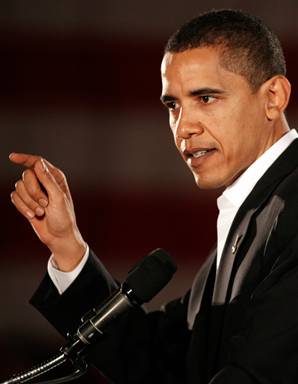
It's the morning after the Indiana and North Carolina primaries. It now seems pretty clear to everyone that Barack Obama is going to be the Democratic nominee for President. The question now is -- what can we do to ensure that he defeats John McCain in November. And not only defeats McCain, but defeats him decisively.

We need more than a Democratic victory in November -- we need a landslide. We need huge Democratic majorities in the House and Senate. We can only achieve that if we have the kind of unbeatable team at the top that unites the party and the nation.

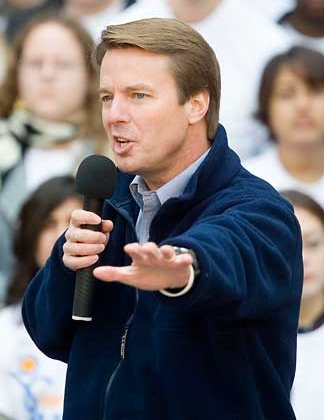
It's obvious that Hillary Clinton is not going to be Obama's running mate. Obama has to choose from among many outstanding Democrats, including some who ran against him in the early primaries, to find a great Vice Presidential choice. But one man stands head and shoulders above all the others as the obvious choice: John Edwards.

John Edwards set the agenda for all the candidates in the early stages of the primary battles. He came up with the first and best comprehensive health care plan. He raised the issue of poverty as no leading politician has done for 40 years. His charisma, his abilities and his appeal to those voters Obama must win in November are beyond dispute.

An Obama-Edwards ticket in November is the Democratic party's best chance of winning a resounding victory. If you agree, please visit http://www.ericlee.info/edwards4veep and sign the form there. (That address will soon be http://www.edwards4veep.org.)

We'll make sure that Obama gets this message loud and clear from the many Democrats who we're sure agree with us.