The silent war - by Frank Falla
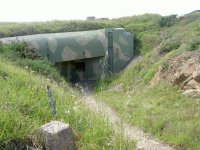 I've just come back from a week-long holiday in the Channel Islands, spending time on both Guernsey and Sark. In addition to the rural quiet, spectacular scenery and delicious local food, one attraction for me was to see the one part of the British Isles that came under German Nazi rule during the Second World War. (Pictured: German gun emplacement on Guernsey's north shore.)
I managed to visit such sites as the underground German military hospital, dug by slave labourers over the course of three years, and the underground military museum in St. Peter Port which was originally built by the Germans to hold petrol reserves for their u-boats. I climbed onto a German gun emplacement overlooking a lunar landscape on the island's north shore, and stayed overnight in a hotel on Sark which was the location of a famous British commando raid. (The commandos managed to kill a couple of German officers whose hands were tied, and this reportedly triggered Hitler's infamous command to treat captured commandos not as prisoners of war, but as terrorists.)
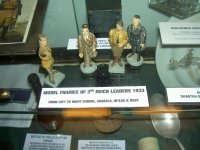
"Action figures" of Nazi leaders -- one of the stranger items on display at Guernsey's occupation museum.
And of course I bought several books about the Channel Islands under German occupation, and Frank Falla's was the first I read. Falla was a journalist working for one of Guernsey's two daily newspapers at the time of the German invasion in 1940. His account is a fair and balanced one (to coin a phrase), and is made much more interesting by the fact that Falla himself was later involved in the production of a daily underground news sheet which consisted mainly of transcriptions of BBC radio broadcasts. (The Germans had ordered all radios turned so that the islanders could not listen to the BBC.)
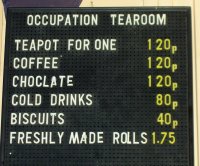
Price list at the "Occupation Tearoom" in the museum.
Falla and his colleagues were eventually betrayed to the Nazis, and were sent to prison in Germany. Several of them died there, but Falla -- liberated by American troops -- was eventually returned to Guernsey.
What was interesting in his account was the bitterness he felt at the fact that no one who collaborated with the Germans, no one who became rich on the black market, no one who informed on people like himself -- none of these people were ever punished after the war.
He doesn't go so are as to say that the leadership in Guernsey was guilty of collaboration, but his own anger and bitterness are still clear in a book written two decades after the event.