" /> Eric Lee: May 2006 Archives

« April 2006 | Main | June 2006 »

May 19, 2006

From BibiWATCH to the Blogosphere

[Editor's note: Several issues of BibiWATCH are now available once again to read on this blog. Click here.]

Palestinian suicide bombers attack Tel-Aviv. The Israeli government blames Hamas. As support within Israel for any kind of peace deal with the Palestinians withers, pundits write that the Oslo process is dead.

It is June 1996 and Binyamin "Bibi" Netanyahu has just been elected Israel's Prime Minister.

Ordinarily, journalists begin articles that way to make the case that nothing has changed, or ever will change. But I want to do the opposite: to write about how much has changed in the last ten years in at least one important area.

When Netanyahu was elected, only months after the assassination of Yitzhak Rabin, I was living on a kibbutz in the northern part of Israel. Active in the peace movement, a supporter of the left-wing Meretz party, I was devastated by the election result. The morning after -- literally the morning after, as election night was a cliffhanger -- one could see the shock in the faces of kibbutz members. After all the hope of the Rabin-Peres years, the beginnings of what seemed to be a reconcilation with not only the Palestinians but the entire Arab world, we awakened to a new reality.

It was then that I launched what was probably the first political blog in Israel. The word 'blog' didn't yet exist, but that is exactly what 'BibiWATCH' was. Every Monday over the course of two years, I churned out an article.

In the very first edition of BibiWATCH, on 10 June 1996, I wrote about the government Netanyahu was likely to form. After listing the mostly likely candidates for the various ministerial posts, one worse than the other, I ended with, "It's going to be a long four years."

I was wrong about that. It was only three years before Netanyahu's increasing unpopularity drove him from office. But in the course of those three years, he managed to sabotage and eventually kill off the Oslo peace process, which was his intention. Even if today Netanyahu is -- thankfully -- lost in the political wilderness, his lasting achievement is that he destroyed what Yitzhak Rabin had so painfully built.

The Israelis and Palestinians may be back to where they were in 1996 (or before), but blogging has moved on a bit.

Back in 1996, it really seemed as if blogs could change the world. For example, a year after Netanyahu's election victory, I suggested that all websites which saw this as a catastrophe should turn their home pages black in mourning. Amazingly, all the websites of Israel's opposition parties and peace movements did so. The story was picked up by the country's leading daily newspaper which, in a full page spread, claimed that the 'Internet Blackout' of 1997 was a well-funded operation backed by the economic power of the kibbutz movement. (Actually, it was all done free of charge.)

In those days, not many people were online, but there were enough to ensure that BibiWATCH was well-read, and generated its share of fan mail, hate mail and death threats. One of the regular weekly readers was based in Netanyahu's office. Once, after writing a column that suggested -- for the first time -- that Netanyahu had said something true, I received an email from the Prime Minister's office thanking me for this.

But mostly I said nasty things, every one of which was deserved. They were usually things being said by others in the Israeli press -- things which were commonplace in the Israeli media, but which shocked some Jews outside the country. (The irony of receiving emails from people in places like Los Angeles telling me that I was 'anti-Israel' was not lost on me at the time.)

And sometimes I would put together pieces of a jigsaw in a slighly more original way. I was particularly proud of having discovered some of the connections between Netanyahu and the Russian Mafia. Ultimately it was accusations of corruption more than the destruction of the peace process that probably brought Netanyahu down.

A decade ago, you could denounce a prime minister online and be certain that someone in his office was reading what you wrote and might even answer you. You could launch an online campaign (such as the Internet Blackout) and get lots of free publicity in offline media. And you could feel that this new medium was something extraordinarily powerful, and that politics would never be the same.

May 11, 2006

Workers of the world - you have nothing to lose but your ZIP codes

Workers of the world -- okay, it's too much to ask for you to unite. But at least try to understand that there are some workers who do not live in your country.

If that sounds like it's a little bit harsh, maybe you haven't visited some union websites lately.

Here are a three examples, all taken from the USA:

* Wal-Mart is the world's number one anti-union employer, with around 1.7 million employees. One third of its stores are currently located outside the USA, with that number rapidly expanding. Unions have correctly thrown massive resources at global campaigns targetting the company. At the center of one of those efforts is the wonderful Wal-Mart Watch website. At the very top of every page, it (correctly) reminds visitors that they can "Receive updates and local alerts on how you can take action against Wal-Mart" -- asking them for their email addresses. And ZIP codes. But people outside of the USA don't have ZIP codes. (There's no indication on the site that putting in your ZIP code is optional, which it is.)

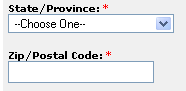
* The United Students Against Sweatshops (USAS) -- a very worthwhile organization which I hesitate to criticize -- is running an online campaign in support of workers in El Salvador. I'd love to send off a message, but I can't. Their online form requires me to select which US state or Canadian province I live in.

* If you're looking to buy union products, you can visit the AFL-CIO's website, click through to ShopUnionMade.org (this is sounding promising), and you wind up at a website called 'America@Work' offering you '100% American-made' things to buy. As on so many US union websites, "Buy union" and "Buy American" seem to be synonyms.

The corporate world is increasingly becoming aware of these issues. Web usability guru Jakob Nielsen has written some guidelines suggesting the minimum that companies should do to ensure "that international users can use your site". What applies to companies applies equally well to us. Does your union website meet all (or any) of these guidelines?

1. On your web-based forms, make the field for name a single field -- not separate fields for first and last names. Why not? In many countries, people only have one name. And in some countries, the first name is the family name. (Think China.)

2. Use Unicode on your site to correctly display -- and receive -- non-Latin characters, or even Latin characters with accents. If you don't know what Unicode is and you're responsible for a union website, it's time you learned.

3. Don't use the expression 'ZIP code' if you want visitors from outside the US to use your site. If you are collecting postal addresses, use something like "Postal/ZIP code" instead.

4. Don't require state or province on a form if you want people from outside of the USA and Canada to be able to sign up.

5. For phone numbers, allow for international numbers containing a varying number of digits and a country code -- and allow people to key in the plus (+) character which is often used to indicate the international dialling prefix. Many sites currently block such characters, or require phone numbers to be put into fixed-size fields which are not appropriate outside the USA.

6. If you're using any measurements on your site, make sure you have them in their metric equivalents. In most of the world, people have no idea what an "inch" means. This is particularly important when discussing health and safety issues. Imagine the confusion if a reader outside of the USA reads that Americans are allowed to work outdoors when the temperature is, say, 40 degrees. In Celsius, that's very hot.

7. For dates, spell out the name of the month. In most of the world, 9/11 is the ninth of November.

8. Where possible, make your site available in multiple languages. Even if your site is only aimed at, for example, residents of the USA, you will want it to be available in Spanish as well as English.

Some of this admittedly sounds trivial. And of little concern to those of you who are not union webmasters.

But think back to our examples. If USAS had followed these guidelines, it would have more people from around the world sending off protest messages in support of those workers in El Salvador. And Wal-Mart Watch would begin to get people active who live outside the USA -- even Canadians -- and who want to campaign against the company.

As for "Buy union" and "Buy American" being used interchangeably -- well, Jakob Nielsen's guidelines don't help much there. Convincing trade unionists that their real allies are their fellow workers in all countries (and not their employers at home) is what it's all about, isn't it?

May 03, 2006

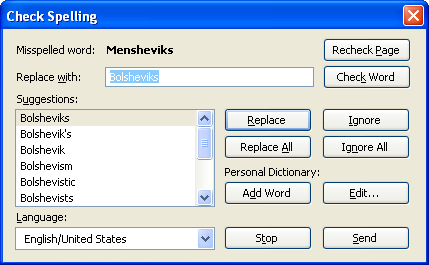
Mozilla takes sides in 100 year old split in the Russian Social Democratic Party

More than 100 years after the Russian Social Democratic Party split into its Menshevik and Bolshevik wings, the open source web browser Mozilla has clearly taken sides. This screen shot taken from the Mozilla email client (Thunderbird) needs no further comment: